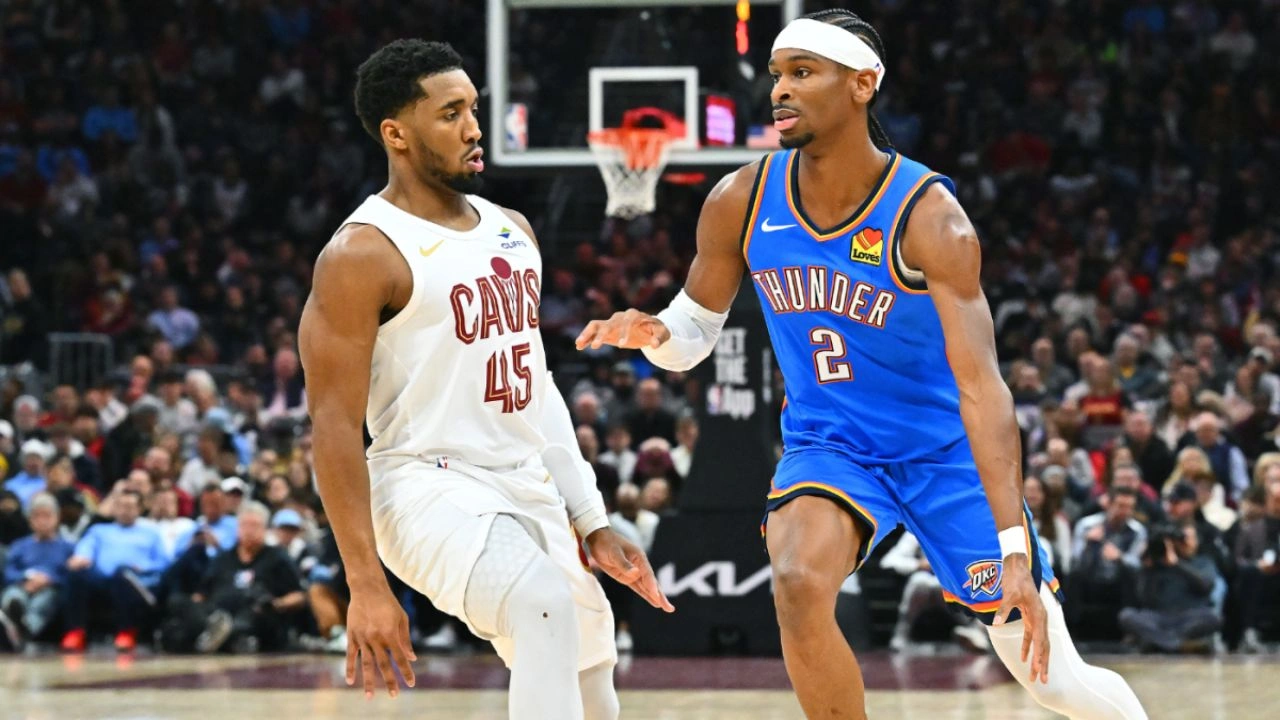
thunder vs cavaliers: The Oklahoma City Thunder sent a clear message to the rest of the NBA by dismantling the Cleveland Cavaliers 136–104 in a dominant road performance that showcased elite scoring, depth, and tactical precision. More than just another regular-season victory, this blowout represented a defining moment in Oklahoma City’s rise as a legitimate championship contender and exposed key vulnerabilities in Cleveland’s game plan.
From the opening tip to the final buzzer, the Thunder controlled every major phase of the contest—offense, defense, tempo, and shot selection. Their stars shined, their role players delivered, and their coaching adjustments proved decisive. For Cleveland, the night was a harsh reminder of the gap that still separates them from the NBA’s top tier.
This in-depth breakdown explores how Oklahoma City dominated, what went wrong for Cleveland, and why this game could shape both franchises’ trajectories moving forward.
The Bigger Picture: Why This Game Mattered
While January games rarely define a season, certain matchups reveal deeper truths. Oklahoma City entered this contest riding high, boasting one of the league’s best records and a reputation for disciplined, high-IQ basketball. Cleveland, meanwhile, was searching for consistency and validation against elite competition.
The 136–104 result was not a fluke. It was the product of superior execution, deeper rotation strength, and a more advanced offensive system. The Thunder didn’t merely outscore Cleveland—they out-thought them, out-hustled them, and out-prepared them.
This game matters because it highlighted the structural differences between a team ready for championship contention and one still navigating identity challenges.
Shai Gilgeous-Alexander: MVP-Caliber Leadership
A Masterclass in Control and Efficiency
Shai Gilgeous-Alexander once again proved why he belongs in every serious MVP conversation. Scoring 30 points with clinical efficiency, he dictated the pace of the game without forcing shots or hijacking possessions.
What made his performance exceptional wasn’t just the scoring total—it was how effortlessly he created high-quality shots. Whether attacking the rim, stopping on a dime for mid-range pull-ups, or drawing defenders before dishing to open shooters, Shai orchestrated Oklahoma City’s offense with surgical precision.
Beyond the Box Score
His impact went far beyond points. Gilgeous-Alexander’s off-ball movement collapsed Cleveland’s defensive structure, opening lanes for cutters and shooters. His defensive positioning disrupted passing lanes and triggered fast-break opportunities.
In short, he played the kind of complete game that defines elite two-way superstars.
Chet Holmgren: The Unicorn Who Stretched the Floor
Offensive Versatility at Its Peak
Chet Holmgren delivered one of his most polished performances of the season, scoring 28 points while grabbing eight rebounds and altering countless defensive possessions.
What makes Holmgren uniquely dangerous is his dual-threat nature. Cleveland struggled to decide whether to guard him with a traditional big man or a smaller defender. Either choice proved costly.
- When defended by centers, Holmgren stepped out beyond the arc.
- When guarded by wings, he punished mismatches in the post.
Defensive Impact
On the other end, Holmgren’s rim protection disrupted Cleveland’s interior scoring attempts. His length forced Cleveland’s guards to either hesitate or settle for low-percentage floaters.
Holmgren’s presence alone changed Cleveland’s shot selection—and not in their favor.
The Thunder’s Depth: The True Game-Changer
Isaiah Joe and Luguentz Dort Step Up
Oklahoma City’s depth advantage was glaring. Isaiah Joe and Luguentz Dort each contributed 18 points, spacing the floor and keeping Cleveland’s defense in constant rotation.
Joe’s quick-release shooting punished late close-outs, while Dort’s physical drives and perimeter defense added a gritty edge that Cleveland couldn’t match.
Bench Contributions
Unlike many teams that collapse when their starters rest, the Thunder maintained intensity and structure with their second unit. Ball movement remained crisp. Defensive assignments stayed disciplined. Cleveland never found a window to regain momentum.
This is the hallmark of a championship-level roster.
Cleveland’s Struggles: A Night of Missed Opportunities
Donovan Mitchell’s Inefficient Night
Donovan Mitchell led the Cavaliers with 19 points, but his shooting efficiency told a more troubling story. Going 5-for-18 from the field and just 1-for-9 from three, Mitchell couldn’t generate consistent offense against Oklahoma City’s perimeter pressure.
Defenders funneled him into help defense, forcing contested jumpers and rushed drives. Without a secondary creator consistently relieving pressure, Mitchell was left trying to manufacture offense against an elite defensive system.
A Lack of Offensive Identity
While Evan Mobley, Jarrett Allen, Jaylon Tyson, and De’Andre Hunter each scored 16 points, Cleveland lacked a clear offensive hierarchy. Possessions often devolved into isolation attempts or late-clock jumpers.
The absence of consistent ball movement allowed Oklahoma City’s defense to stay organized and anticipatory.
Three-Point Shooting: The Hidden Battlefield
Oklahoma City’s Shooting Explosion
The Thunder buried 23 three-pointers—one of their highest totals of the season. But this wasn’t random hot shooting. These shots were the result of intentional spacing, drive-and-kick action, and off-ball screens.
Defensive breakdowns by Cleveland left shooters wide open, and Oklahoma City punished every mistake.
Cleveland’s Perimeter Woes
By contrast, Cleveland struggled mightily from beyond the arc. Poor shot selection and rushed attempts contributed to low shooting percentages. More importantly, missed threes triggered fast breaks for Oklahoma City, compounding the damage.
In today’s NBA, three-point differential often determines outcomes. In this game, it decided everything.
Tactical Breakdown: How the Thunder Out-Coached the Cavaliers
Spacing and Ball Movement
Oklahoma City ran a beautifully spaced offense that constantly shifted Cleveland’s defensive coverage. They avoided stagnant isolations and instead prioritized:
- Early ball reversals
- Weak-side cuts
- Drive-and-kick sequences
This kept Cleveland guessing and created high-value shot opportunities.
Defensive Discipline
The Thunder’s defense didn’t rely on gambling or reckless pressure. Instead, it emphasized:
- Forcing ball handlers toward help defenders
- Closing out under control
- Switching intelligently on screens
Cleveland found no easy baskets, no rhythm, and no momentum.
Game Flow: From Early Control to Total Domination
First Quarter: Setting the Tone
Oklahoma City opened with relentless pace and energy, scoring 32 points in the first quarter. Cleveland fell behind early and never truly recovered.
Third Quarter: Cleveland’s Brief Push
Midway through the third quarter, the Cavaliers briefly trimmed the deficit to single digits. However, this surge was short-lived. A quick Oklahoma City run—sparked by Holmgren and Joe—restored a commanding lead.
Fourth Quarter: The Kill Shot
Early in the fourth, the Thunder unleashed a devastating scoring burst that ballooned the lead to over 30 points. The Cavaliers emptied their bench soon after, conceding defeat.
Injury Context: Why Depth Mattered
Oklahoma City played without Jalen Williams, a key rotation player sidelined with a hamstring strain. Despite this, their structure and efficiency never wavered.
Cleveland, meanwhile, missed Darius Garland and Sam Merrill—two players critical to their offensive flow and perimeter shooting. Their absence magnified Cleveland’s lack of creation and spacing.
This contrast further highlighted Oklahoma City’s superior roster construction and adaptability.
What This Win Means for Oklahoma City
Championship Credentials Confirmed
With this victory, the Thunder solidified their reputation as one of the league’s elite teams. Their ability to dominate quality opponents on the road reflects:
- Tactical maturity
- Roster depth
- Star leadership
- Defensive cohesion
These are the ingredients of a legitimate title contender.
Shai’s MVP Case Strengthens
Gilgeous-Alexander’s consistency, efficiency, and two-way impact continue to elevate his MVP narrative. Performances like this strengthen his case as one of the league’s most valuable players.
What This Loss Means for Cleveland
A Reality Check
This game exposed Cleveland’s vulnerability against disciplined, high-IQ teams. Their reliance on isolation offense and inconsistent three-point shooting leaves them ill-equipped to compete with top contenders.
Strategic Adjustments Needed
Cleveland must prioritize:
- Improved ball movement
- More off-ball action
- Better shot selection
- Defensive communication
Without these adjustments, similar blowouts may become routine against elite opponents.
Read Also: Thunder Dominate Cavaliers: A Statement Win That Redefines NBA Power Rankings
Key Lessons from the Thunder’s Victory
- Balanced scoring wins championships
Oklahoma City didn’t rely on a single star. Their offense flowed through multiple creators and finishers. - Spacing creates efficiency
Their floor spacing generated high-value shots and neutralized Cleveland’s defensive schemes. - Defense fuels offense
Smart rotations and forced turnovers led directly to easy transition baskets. - Depth determines resilience
The Thunder maintained performance levels regardless of lineup changes.
Conclusion: A Win That Echoes Across the NBA
The Thunder’s 136–104 demolition of the Cavaliers was not merely a statistical anomaly—it was a blueprint for modern NBA dominance.
Oklahoma City showcased everything a championship contender needs: superstar leadership, elite spacing, defensive intelligence, and deep rotational strength. Cleveland, on the other hand, was left searching for answers and structural solutions.
If this game is any indication of what lies ahead, the Thunder are not just building for the future—they are ready to win now.
3 thoughts on “Thunder Dominate Cavaliers: A Statement Win That Redefines NBA Power Rankings”