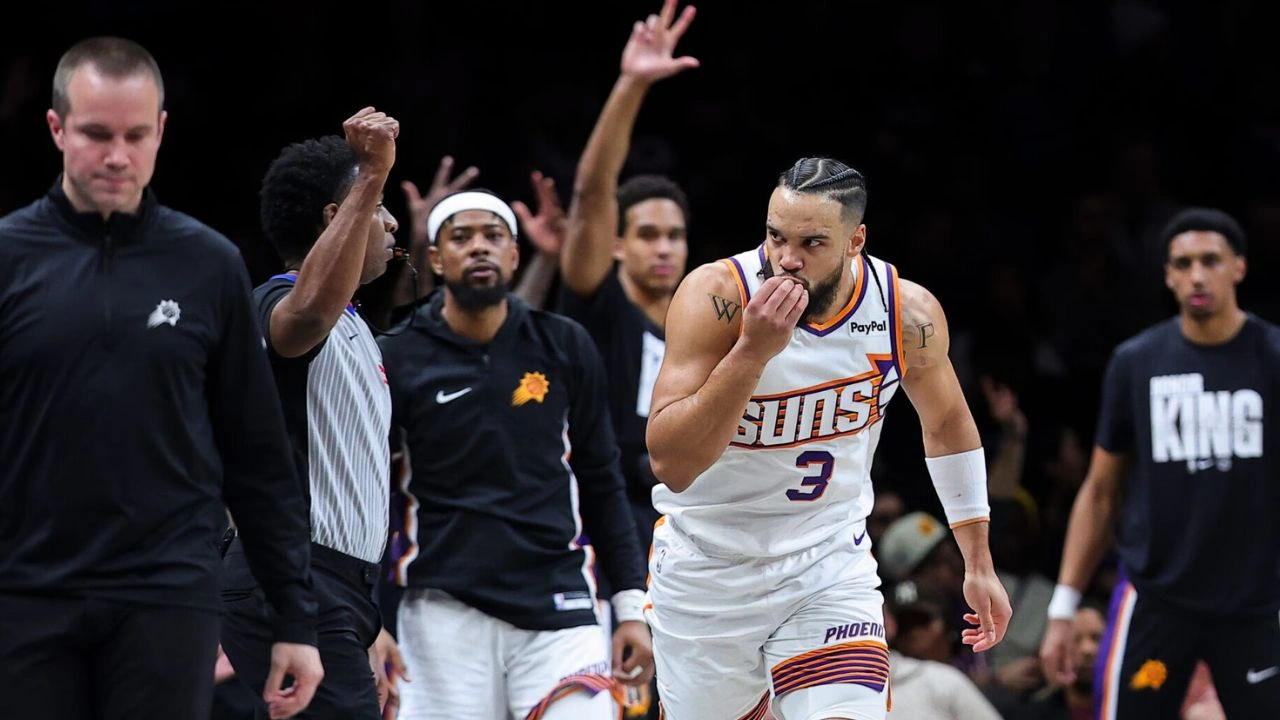
suns vs nets: The Phoenix Suns delivered one of their most complete offensive performances of the season by defeating the Brooklyn Nets 126–117 on the road, showcasing elite shooting efficiency, balanced scoring, and tactical discipline. More than just a routine win, this game represented a pivotal moment for Phoenix’s momentum and an unsettling continuation of Brooklyn’s struggles.
Led by Dillon Brooks’ 27 points and Devin Booker’s composed 23-point outing, the Suns executed a near-flawless offensive game plan, building a commanding early lead and holding off a late Nets rally. Phoenix shot a blistering 57% from the field and an extraordinary 51% from three-point range, turning the Barclays Center into a hostile environment for the home team.
For Brooklyn, the loss underscored familiar themes: inconsistent defense, depleted depth due to injuries, and an inability to sustain momentum against elite offensive execution.
This in-depth analysis explores how the Suns dominated, what went wrong for the Nets, why this game matters in the broader NBA context, and what both teams must address moving forward.
Why This Game Mattered
While the NBA regular season is long, certain matchups reveal more than just box-score results. This Suns vs Nets game was one of those moments.
For Phoenix, the contest represented:
- A chance to solidify their road confidence
- An opportunity to fine-tune offensive chemistry
- A test of depth and shot-making consistency
- Momentum building ahead of a difficult road stretch
For Brooklyn, the stakes were far heavier:
- A desperate need for a morale-boosting win
- An attempt to snap a brutal losing streak
- A test of roster resilience amid injuries
- A chance to prove competitiveness against playoff-caliber opponents
The outcome delivered clarity for both franchises — and the results were starkly different.
Phoenix’s Offensive Explosion: Efficiency at Its Finest
A Shooting Clinic from the Opening Tip
The Suns wasted no time establishing offensive dominance. From their first few possessions, Phoenix displayed a sharp, synchronized attack that overwhelmed Brooklyn’s defensive rotations.
Phoenix shot:
- 57% overall from the field
- 51% from three-point range (20-for-39)
These numbers aren’t just impressive — they are demoralizing for opposing defenses.
The Suns moved the ball decisively, attacked mismatches without hesitation, and punished late close-outs. Every Nets defensive mistake resulted in an open look or a high-percentage finish at the rim.
Dillon Brooks: The Unexpected Offensive Catalyst
Dillon Brooks delivered his best offensive performance in a Suns uniform, scoring 27 points while maintaining composure and shot discipline.
Brooks:
- Attacked close-outs aggressively
- Knocked down open threes
- Finished through contact
- Provided perimeter defense on the other end
His ability to score without disrupting offensive flow was critical.
Brooks’ performance represented more than just a scoring outburst — it demonstrated Phoenix’s growing ability to extract value from secondary scorers.
Devin Booker: Quietly Dominant Leadership
While Brooks led in points, Devin Booker’s 23-point performance was arguably the most impactful.
Booker:
- Controlled tempo
- Initiated half-court offense
- Exploited mismatches
- Created open shots for teammates
What separated Booker’s night was efficiency and patience. He didn’t force shots. Instead, he waited for Brooklyn’s defensive breakdowns and capitalized methodically.
His presence stabilized Phoenix during Brooklyn’s fourth-quarter push, making clutch shots when the game threatened to tighten.
The Supporting Cast: Balanced Scoring Wins Games
Phoenix’s victory wasn’t built on star power alone. The Suns received contributions from nearly every rotation player.
Collin Gillespie’s Breakout Night
Collin Gillespie delivered a standout performance, scoring 22 points with confidence and efficiency.
Gillespie:
- Hit open threes
- Attacked mismatches
- Provided secondary ball-handling
- Played with composure under pressure
His emergence added a critical layer of offensive depth for Phoenix.
Grayson Allen’s Bench Spark
Grayson Allen provided 14 points off the bench, injecting energy and momentum when Phoenix needed stability.
Allen’s movement shooting:
- Stretched Brooklyn’s defense
- Opened driving lanes
- Forced defensive rotations
His contributions maintained offensive rhythm when starters rested.
Mark Williams’ Interior Presence
Mark Williams added 16 points and eight rebounds, providing interior scoring and second-chance opportunities.
Williams’ activity:
- Punished mismatches in the paint
- Secured offensive rebounds
- Set physical screens
His presence forced Brooklyn’s defenders to collapse inside, creating perimeter opportunities.
Brooklyn’s Defensive Collapse: A Familiar Problem
Late Rotations and Poor Close-Outs
Brooklyn’s defense struggled to contain Phoenix’s ball movement.
The Nets repeatedly:
- Lost shooters in transition
- Closed out late on perimeter attempts
- Failed to rotate effectively
- Allowed open corner threes
These breakdowns fueled Phoenix’s early run and built a double-digit deficit that proved insurmountable.
Inability to Contain Dribble Penetration
Phoenix consistently broke down Brooklyn’s perimeter defense off the dribble.
This forced:
- Help defenders to collapse
- Kick-outs to open shooters
- Rotational chaos
Brooklyn never regained defensive structure.
Brooklyn’s Offensive Effort: Individual Brilliance, Collective Struggles
Despite the loss, Brooklyn had a few bright spots.
Michael Porter Jr.: Leading the Scoring Charge
Michael Porter Jr. led the Nets with 23 points, providing shot-making and physical drives.
Porter Jr.:
- Attacked mismatches
- Hit contested jumpers
- Finished in traffic
However, his scoring came mostly in isolation, limiting offensive flow.
Noah Clowney’s Promising Development
Noah Clowney scored 16 points, showcasing perimeter shooting and interior finishing.
Clowney’s versatility:
- Stretched the floor
- Created matchup problems
- Showed defensive effort
He remains one of Brooklyn’s most intriguing young pieces.
Ziaire Williams’ All-Around Contribution
Ziaire Williams added 15 points, contributing in transition and attacking the rim.
Williams’ athleticism:
- Generated fast-break points
- Created second-chance opportunities
- Provided defensive energy
However, Brooklyn lacked a consistent secondary creator.
The Injury Context: Brooklyn’s Roster Depletion
Brooklyn entered the game severely undermanned.
They were without:
- Cam Thomas (primary scorer)
- Egor Demin (rookie guard)
- Day’Ron Sharpe (backup center, illness)
These absences crippled Brooklyn’s depth and shot creation.
Without Thomas, the Nets lacked a go-to scorer capable of generating offense late in the shot clock.
Game Flow: How Phoenix Built and Sustained Control
First Half: The Suns Set the Tone
Phoenix dominated the first half, building a lead that reached 20 points.
Key factors:
- Red-hot shooting
- Transition scoring
- Defensive stops
Brooklyn struggled to generate quality looks.
Third Quarter: Nets Show Resistance
Brooklyn opened the second half with renewed intensity, trimming the deficit with aggressive drives and perimeter shooting.
However, every Nets run was answered by:
- A Booker jumper
- A Brooks three
- A Gillespie drive
Phoenix never lost composure.
Fourth Quarter: Late Drama, Suns Close It Out
Brooklyn made one final push, cutting the lead to 118–114.
At this moment, Phoenix:
- Slowed the game down
- Ran high-efficiency sets
- Executed late-game offense
Booker delivered clutch shots and free throws to seal the victory.
Tactical Breakdown: Why Phoenix Won
Ball Movement and Spacing
Phoenix prioritized:
- Quick passes
- Weak-side cuts
- Drive-and-kick action
This spacing forced Brooklyn into constant rotations.
Shot Selection Discipline
The Suns avoided forced shots.
Instead, they:
- Attacked mismatches
- Waited for defensive breakdowns
- Took high-percentage looks
Defensive Discipline
Phoenix didn’t gamble defensively.
They:
- Forced contested jumpers
- Protected the paint
- Closed out under control
Brooklyn never found rhythm.
What This Win Means for Phoenix
Momentum Building
This road win strengthens Phoenix’s playoff positioning and confidence.
They now:
- Trust their offensive identity
- Believe in depth contributions
- Execute with discipline
Offensive Chemistry Improving
Phoenix’s ball movement and shot selection reflect growing chemistry.
That cohesion is critical for postseason success.
Depth Becoming a Weapon
The emergence of players like Gillespie and Allen gives Phoenix lineup flexibility.
This depth reduces reliance on star scoring.
What This Loss Means for Brooklyn
Structural Problems Persist
Brooklyn’s defensive issues are systemic.
They must address:
- Rotational discipline
- Defensive communication
- Perimeter containment
Injury Management and Depth Planning
Without Cam Thomas, Brooklyn lacks scoring punch.
Roster adjustments may be inevitable.
Development Over Results
At this stage, Brooklyn’s season outlook leans toward development.
Clowney, Williams, and Porter Jr. represent building blocks.
Read Also: Suns Defeat Nets 126–117: Phoenix Delivers a Road Statement as Brooklyn’s Season Slips Further
Key Takeaways
- Efficiency wins games
Phoenix’s shooting accuracy made the difference. - Depth matters
Balanced scoring sustained Phoenix’s lead. - Defense fuels offense
Stops created transition opportunities. - Injuries change everything
Brooklyn’s absences proved decisive.
Conclusion: A Tale of Two Trajectories
The Suns’ 126–117 victory over the Nets wasn’t just about points.
It was about:
- Discipline
- Execution
- Depth
- Leadership
Phoenix looks increasingly like a playoff-ready team with a maturing identity.
Brooklyn, meanwhile, faces tough decisions about roster construction, defensive priorities, and long-term direction.
As the season progresses, this game may be remembered as a turning point — one that separated momentum from stagnation.
1 thought on “Suns Defeat Nets 126–117: Phoenix Delivers a Road Statement as Brooklyn’s Season Slips Further”