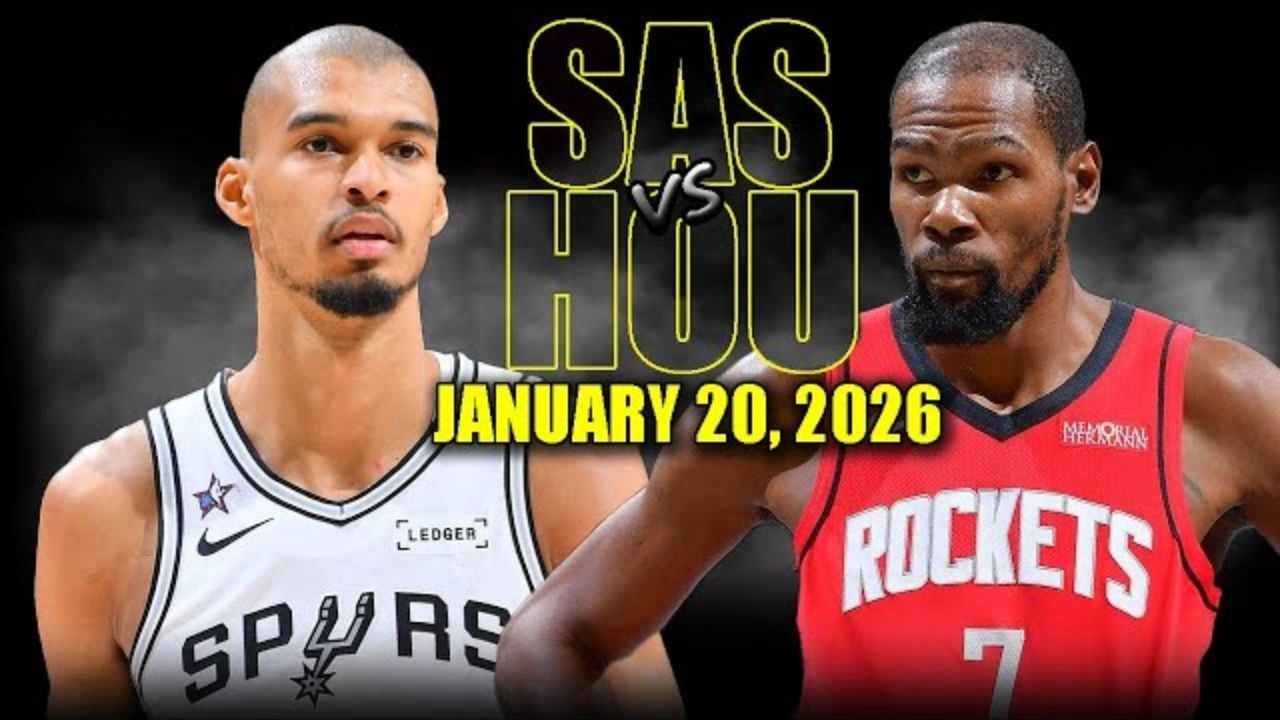
spurs vs rockets: The Houston Rockets delivered a powerful reminder of their growing maturity and resilience by overturning a significant early deficit to defeat the San Antonio Spurs 111–106 in a compelling NBA regular-season showdown. In a game filled with momentum swings, young stars, and late-game drama, Alperen Şengün emerged as the emotional and tactical anchor, guiding Houston through adversity with poise and intelligence.
What began as a promising night for the Spurs slowly transformed into a statement victory for the Rockets—one that highlighted Houston’s evolving identity as a team capable of closing games under pressure.
A Tale of Two Halves in Texas Rivalry
This matchup carried extra intensity, as any meeting between the Rockets and Spurs inevitably does. Both franchises are in different phases of rebuilding, yet each possesses young talent eager to define the future.
From the opening tip, the Spurs looked sharper. Their ball movement was crisp, their spacing effective, and their shooting confident. Houston, meanwhile, appeared sluggish and struggled to find offensive rhythm, particularly in transition defense.
By the midpoint of the second quarter, San Antonio had built a commanding lead, at one point stretching the advantage to 16 points, putting the Rockets firmly on the back foot.
Spurs Dominate Early Behind Hot Shooting
San Antonio’s early success was driven by Julian Champagnie, who caught fire from beyond the arc. His shooting stretched Houston’s defense and created space for others to operate.
Champagnie’s ability to score without dominating the ball allowed the Spurs to maintain offensive flow. Each made three-point shot seemed to sap confidence from the Rockets while energizing the home crowd.
Adding to Houston’s struggles, Victor Wembanyama made his presence felt on both ends of the floor. While his scoring numbers were modest early, his rim protection and rebounding disrupted the Rockets’ interior game.
Read Also: Dallas Mavericks Dominate Knicks 114–97: What the Statement Win Reveals About Both Teams
Rockets Search for Answers Amid Early Struggles
Houston’s first-half performance was uneven. Defensive rotations were late, perimeter coverage inconsistent, and offensive execution lacked precision. Turnovers and missed opportunities compounded the issue, allowing San Antonio to control tempo.
Despite the difficulties, the Rockets avoided complete collapse thanks to Alperen Şengün’s steady influence. Even when shots weren’t falling, Şengün remained active—facilitating offense, battling on the boards, and keeping teammates engaged.
His composure prevented the deficit from ballooning further, setting the stage for a second-half resurgence.
Halftime Reset Sparks Houston’s Revival
At halftime, the Rockets regrouped with renewed focus. The coaching staff emphasized defensive intensity, better ball movement, and patience in half-court sets.
The message resonated immediately.
Houston emerged from the locker room with noticeably higher energy. Defensive communication improved, closeouts became sharper, and the offense began to flow more naturally.
The third quarter marked the beginning of a gradual momentum shift.
Alperen Şengün Takes Control
As the game tightened, Şengün elevated his play, becoming the fulcrum of Houston’s attack.
He scored efficiently in the post, drew double-teams, and consistently found open teammates. His near triple-double—20 points, 13 rebounds, and nine assists—was not just a statistical achievement but a reflection of his all-around impact.
Şengün’s basketball IQ was on full display. He read defensive coverages, adjusted his positioning, and dictated the pace during crucial stretches, forcing the Spurs to react rather than initiate.
Reed Sheppard’s Fourth-Quarter Explosion
While Şengün anchored the team, Reed Sheppard provided the spark that ignited Houston’s comeback.
Sheppard poured in 21 points, with 12 coming in the fourth quarter, showcasing confidence and fearlessness beyond his years. His shot-making came at critical moments—just as the Spurs seemed poised to reassert control.
Each basket from Sheppard chipped away at San Antonio’s lead and shifted momentum. His ability to score under pressure injected belief into the Rockets’ bench and silenced the Spurs’ crowd.
Kevin Durant’s Veteran Influence
Adding stability during the comeback was Kevin Durant, who contributed 18 points and delivered timely scoring when Houston needed calm execution.
Durant’s presence was subtle but crucial. He spaced the floor, made smart decisions, and avoided forcing plays. His experience showed in the way he controlled possessions during tight moments, allowing younger teammates to play freely.
In a game defined by youthful energy, Durant’s steady hand proved invaluable.
Spurs Fight Back but Struggle to Close
Despite Houston’s surge, the Spurs did not fade quietly. Champagnie continued to knock down shots, eventually finishing with 27 points and eight three-pointers, one of his most impressive outings of the season.
Wembanyama contributed a double-double with 14 points and 10 rebounds, battling inside and altering shots. However, as the game entered the final minutes, San Antonio’s execution faltered.
Missed defensive assignments and rushed offensive possessions allowed Houston to seize control when it mattered most.
Decisive Moments in the Final Minutes
With the score tied late in the fourth quarter, the game turned into a test of composure.
Jabari Smith Jr. delivered a clutch fadeaway jumper, giving the Rockets their first lead since the early stages of the game. Moments later, Şengün followed with a critical basket inside, extending Houston’s advantage to two possessions with under 30 seconds remaining.
The Spurs had opportunities to respond but failed to convert, as Houston’s defense tightened and forced contested shots.
When the final buzzer sounded, the Rockets had completed a remarkable turnaround.
Defensive Adjustments Make the Difference
Houston’s comeback was not fueled by offense alone. The Rockets’ second-half defensive improvements were decisive.
Key adjustments included:
- Improved perimeter closeouts
- Stronger help defense in the paint
- Better rebounding discipline
By limiting second-chance opportunities and contesting shots more effectively, Houston gradually wore down San Antonio’s offense.
This defensive commitment underscored the Rockets’ growth as a cohesive unit.
What the Win Says About the Rockets
This victory represented more than just a single win. It reflected Houston’s evolving identity as a team capable of:
- Overcoming adversity
- Trusting young players in big moments
- Executing late-game strategies
Winning three straight games reinforced the belief that the Rockets are moving in the right direction, building habits that translate into sustainable success.
Read Also: Rockets Rally Past Spurs 111–106 as Alperen Şengün Leads Late Comeback
Spurs’ Perspective: Encouraging Signs Amid Disappointment
For the Spurs, the loss was frustrating but not without positives.
Champagnie’s shooting performance and Wembanyama’s continued development offered reasons for optimism. However, the inability to close games remains an area of concern.
Learning how to manage late-game situations will be critical as the Spurs’ young core gains experience.
A Rivalry That Continues to Evolve
Rockets vs. Spurs games have long been defined by intensity, and this matchup was no exception. As both teams continue to rebuild, encounters like this provide valuable benchmarks for progress.
Houston walked away with confidence and momentum. San Antonio left with lessons that could shape future growth.
Conclusion: A Statement Win for Houston
In the end, the Rockets’ 111–106 victory was a testament to resilience, teamwork, and emerging leadership.
Led by Alperen Şengün’s near triple-double, powered by Reed Sheppard’s late scoring, and steadied by Kevin Durant’s experience, Houston demonstrated an ability to adapt and overcome.
As the season unfolds, performances like this suggest that the Rockets are no longer just rebuilding—they are learning how to win.