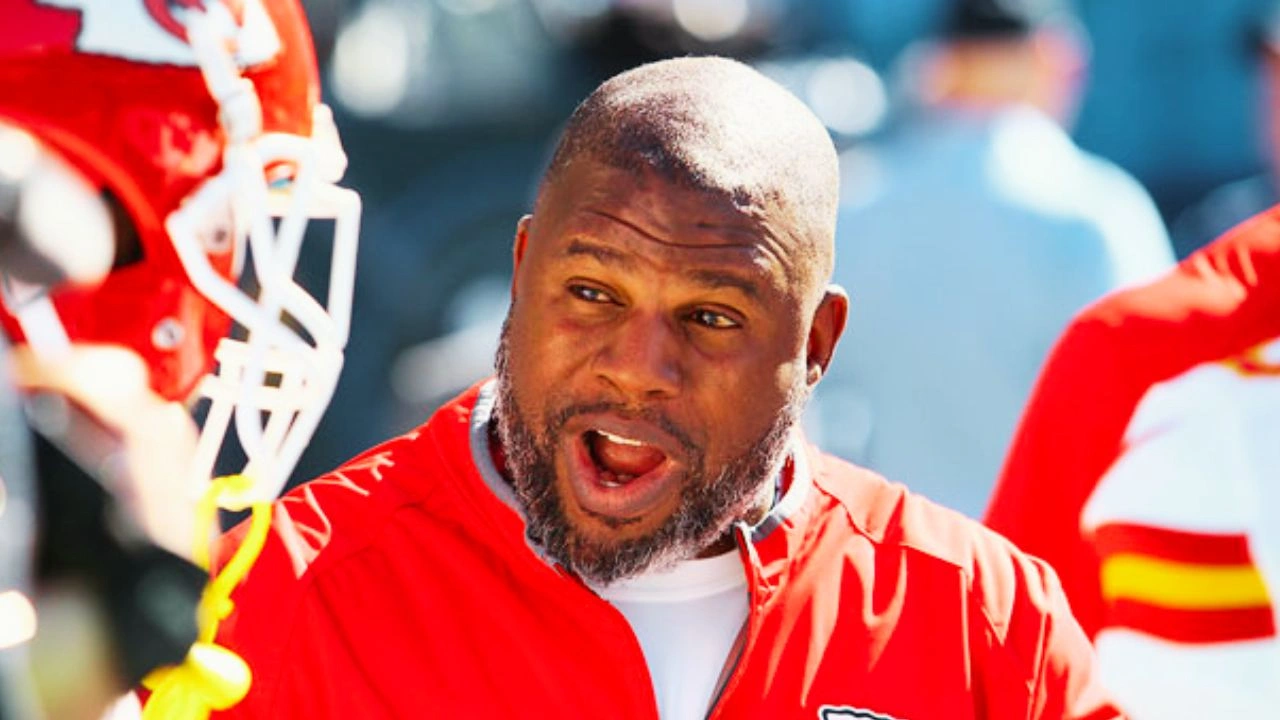
The Kansas City Chiefs are preparing to bring back Eric Bieniemy as their next offensive coordinator, marking one of the most consequential coaching reunions in recent NFL history. For a franchise that dominated the league for nearly a decade and suddenly stumbled into unfamiliar territory, this move represents far more than a nostalgic homecoming. It is a calculated effort to restore offensive excellence, re-establish leadership stability, and reposition the Chiefs as a long-term Super Bowl contender.
Bieniemy’s return comes after a disappointing season in which Kansas City missed the playoffs for the first time in over ten years. With star quarterback Patrick Mahomes recovering from injury, questions surrounding Travis Kelce’s future, and an offense that lost its identity, the Chiefs are signaling a philosophical shift: return to what worked best.
This article breaks down why the Chiefs are rehiring Bieniemy, what his presence changes schematically and culturally, how it impacts Mahomes and the offense, and whether this reunion can realistically ignite another dynasty run.
Why the Chiefs Are Turning Back to Eric Bieniemy
For most of the Andy Reid era, Kansas City represented stability, innovation, and dominance. That aura faded during a turbulent season marked by injuries, inconsistent execution, and a lack of offensive rhythm.
The Chiefs finished with a losing record, their worst showing since Mahomes became the starter. The offense ranked well below its usual standards in efficiency, red-zone execution, and explosive plays. Defensive units around the league adapted, while Kansas City struggled to counter.
Faced with mounting pressure to act decisively, the Chiefs chose a familiar solution: bring back the architect of their most productive offensive years.
Eric Bieniemy served as Kansas City’s offensive coordinator from 2018 to 2022, during which the Chiefs:
- Won two Super Bowls
- Reached four AFC Championship Games
- Led the league in scoring multiple seasons
- Developed Mahomes into a generational quarterback
This wasn’t merely a sentimental hire. It was a recognition that the franchise drifted away from a system that maximized its personnel and maintained accountability at every level.
Read Also: Indiana Stuns Miami to Win College Football Playoff National Championship in Historic Breakthrough
Who Is Eric Bieniemy? A Football Mind Forged by Experience
A Player’s Perspective Turned Coaching Advantage
Before becoming one of the NFL’s most influential offensive minds, Eric Bieniemy was a standout running back at the University of Colorado and later an NFL player. His firsthand experience in offensive systems shaped his coaching philosophy: structure with flexibility, discipline with creativity.
That balance became the hallmark of Kansas City’s offense during his first tenure.
Rising Through the Coaching Ranks
Bieniemy’s coaching journey began at the college level, where he developed a reputation as a tough, detail-oriented teacher. He transitioned to the NFL and joined the Chiefs in 2013 as running backs coach. His impact was immediate, revitalizing Kansas City’s rushing attack and earning the trust of Andy Reid.
By 2018, Bieniemy was promoted to offensive coordinator just as Mahomes was becoming the team’s starter.
What followed was one of the most explosive offensive eras in NFL history.
The Golden Era: Bieniemy’s First Tenure in Kansas City
The Mahomes Breakout
In 2018, Patrick Mahomes threw 50 touchdown passes and won league MVP. While Andy Reid remained the chief architect, Bieniemy’s influence was evident in:
- Aggressive downfield play designs
- Creative red-zone packages
- Heavy use of motion and misdirection
- Flexibility in protection schemes
This system turned Mahomes into a matchup nightmare.
Sustained Excellence
From 2018 to 2022, the Chiefs never finished outside the top tier of offensive production. Even after trading Tyreek Hill, Bieniemy helped reshape the offense into a more balanced, possession-based attack that still generated explosive plays.
The Chiefs won Super Bowls in 2019 and 2022, both with Bieniemy coordinating.
His role was not symbolic. He called plays, managed weekly game planning, and directly coached Mahomes.
What Changed After Bieniemy Left?
In 2023, Bieniemy left Kansas City seeking full autonomy as an offensive coordinator. His departure coincided with significant internal changes.
The Transition to a New Offensive Identity
The Chiefs shifted play-calling responsibilities, introducing new voices and approaches. While early results were serviceable, cracks began to form.
Key issues emerged:
- Predictable formations
- Limited motion
- Reduced vertical threat
- Inconsistent run-pass balance
The offense became easier to defend.
Mahomes’ Injury and Structural Breakdown
Patrick Mahomes suffered a serious injury that disrupted timing, chemistry, and confidence. Without a stable offensive framework, the Chiefs struggled to adapt.
The result: stalled drives, missed opportunities, and a collapse of the offensive identity that once terrified defenses.
Why Bieniemy’s Return Makes Strategic Sense
Re-Establishing a Proven System
Bieniemy brings back a tested offensive framework that already fits Kansas City’s roster.
His schemes emphasize:
- Pre-snap motion
- Layered route combinations
- Quarterback autonomy
- Situational adaptability
These elements are precisely what the Chiefs lost.
Cultural Reset
Perhaps more importantly, Bieniemy is known for accountability. His demanding coaching style enforces discipline, preparation, and execution.
During his earlier tenure, Kansas City’s offense operated with precision. Mental mistakes were rare. That standard faded after his departure.
His return signals a renewed commitment to detail.
How This Impacts Patrick Mahomes
A Familiar Partnership
Mahomes and Bieniemy share a rare quarterback-coordinator bond. Their communication, trust, and shared language streamline play-calling and in-game adjustments.
Mahomes’ most efficient seasons came under Bieniemy’s guidance.
With Mahomes recovering from injury, this familiarity matters more than ever.
Restoring Confidence and Rhythm
Quarterbacks thrive on rhythm. Bieniemy’s offense emphasizes:
- High-percentage throws
- Defined reads
- Protection adjustments
- Tempo variation
This structure reduces mental strain and allows Mahomes to operate instinctively.
The result: fewer forced throws, better timing, and greater efficiency.
What This Means for Travis Kelce and the Skill Players
Kelce’s Usage Could Surge Again
Travis Kelce was a centerpiece in Bieniemy’s offense. The system consistently isolated him in mismatches using motion and stacked formations.
Under the recent system, Kelce’s role became less central and more predictable.
Bieniemy’s return could:
- Restore Kelce’s red-zone dominance
- Increase seam routes and option concepts
- Extend his late-career productivity
Re-Energizing the Wide Receiver Group
Kansas City’s current receivers struggled with separation and timing.
Bieniemy’s route concepts:
- Create natural picks
- Force zone confusion
- Generate space without elite speed
This benefits younger receivers still developing.
The Running Game: A Forgotten Weapon
Bieniemy began his Chiefs career as running backs coach. He understands the importance of balance.
Under his leadership, the Chiefs used the run game strategically:
- To control tempo
- To set up play-action
- To protect late-game leads
The recent offense leaned too heavily on Mahomes.
Expect a more integrated ground attack.
How This Affects Andy Reid’s Legacy
Andy Reid remains one of the greatest offensive minds in NFL history. But his most dominant years coincided with Bieniemy’s presence.
This reunion:
- Preserves Reid’s legacy
- Reinforces continuity
- Reduces internal friction
It also allows Reid to focus on big-picture strategy rather than daily offensive minutiae.
Challenges and Risks
The League Has Evolved
NFL defenses are smarter and more adaptable. Bieniemy cannot simply re-install old playbooks.
He must modernize:
- RPO concepts
- Motion frequency
- Spread formations
- Protection adjustments
Innovation will determine success.
Past External Stints Were Mixed
Bieniemy’s coaching stops outside Kansas City did not yield the same success. This suggests his effectiveness is maximized within Kansas City’s organizational culture.
The Chiefs must ensure alignment.
What This Means for the Chiefs’ 2026 Outlook
A Short-Term Boost
Expect immediate offensive improvement.
With:
- Mahomes returning healthy
- Kelce possibly staying
- Bieniemy calling plays
The Chiefs should rebound into playoff contention.
Long-Term Stability
This move also stabilizes Kansas City’s coaching pipeline.
Bieniemy could become:
- A long-term offensive anchor
- A successor figure
- A culture carrier
Read Also: Pacers vs 76ers Preview: Odds, Predictions, Key Matchups, and What to Expect in Philadelphia
What Fans and Fantasy Players Should Know
For Chiefs Fans
This reunion signals urgency and ambition. The front office is not settling for mediocrity.
Expect:
- Higher scoring games
- More aggressive play-calling
- A return to identity
For Fantasy Football Managers
Mahomes’ fantasy value rises.
Kelce’s role likely expands.
Chiefs receivers gain upside.
Conclusion: A Smart, Necessary Reunion
The Chiefs’ decision to rehire Eric Bieniemy is not about reliving past glory. It is about restoring what made Kansas City unstoppable.
This move:
- Stabilizes the offense
- Maximizes elite talent
- Reinforces accountability
- Re-aligns philosophy
For a franchise that briefly lost its way, Bieniemy’s return could be the catalyst for another golden era.
3 thoughts on “Chiefs Reunite with Eric Bieniemy as Offensive Coordinator: A Strategic Reset for Kansas City”