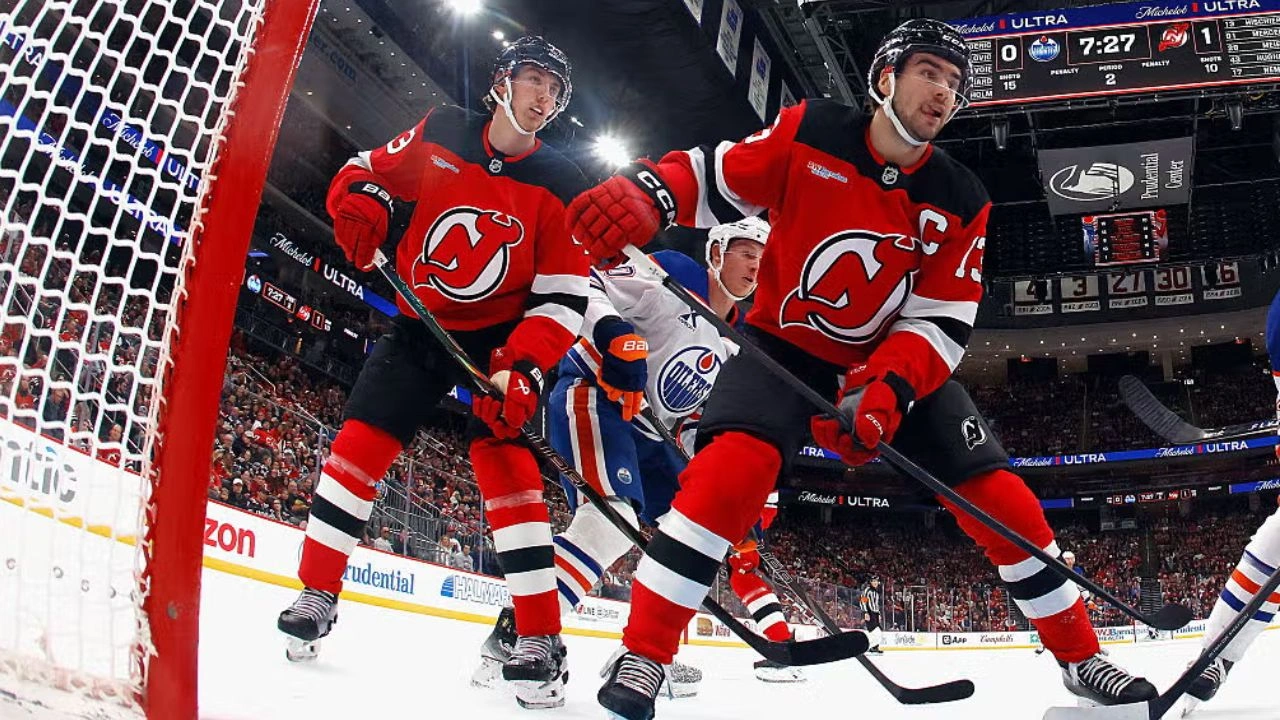
Devils vs Oilers 2–1: In a game that perfectly captured the relentless, physical nature of late-season hockey, the New Jersey Devils defeated the Edmonton Oilers 2–1 in a tightly contested road battle that showcased resilience, discipline, and elite goaltending. It was not a flashy win filled with highlight-reel goals and offensive fireworks. Instead, it was a victory built on structure, patience, and a refusal to bend under pressure.
On a night when fatigue loomed large — the Devils were playing on the second half of a back-to-back — New Jersey dug deep, absorbed wave after wave of Edmonton pressure, and leaned on the calm brilliance of goaltender Jake Allen, who delivered one of his strongest performances of the season.
Goals from Arseny Gritsyuk and Cody Glass, each of whom also recorded an assist, proved enough to overcome a determined Oilers team that pushed relentlessly in the third period but could not solve Allen when it mattered most.
This was not simply another regular-season win. It was a statement.
For the Devils, the result extended a strong stretch of form and strengthened their position in a crowded playoff race. For the Oilers, it was a frustrating reminder of how slim the margins can be when elite offense meets disciplined defense.
In this comprehensive breakdown, we analyze how the Devils earned this gritty victory, the tactical battles that defined the night, Jake Allen’s outstanding performance, what went wrong for Edmonton, and what this game means for both teams as the NHL season heads toward its decisive phase.
Why This Game Mattered
At this stage of the NHL calendar, every point carries enormous weight.
The Devils entered the contest riding momentum, having won four of their previous five games. They were climbing steadily in the standings and trying to solidify their playoff positioning during a demanding road trip.
Edmonton, meanwhile, was seeking to extend a two-game winning streak and continue stabilizing its season after stretches of inconsistency. The Oilers also hoped to take advantage of New Jersey’s fatigue, knowing the Devils were playing their second game in two nights.
Complicating matters further, Edmonton was without one of its biggest stars, Leon Draisaitl, who remained away from the team due to a personal family matter. His absence forced adjustments in the Oilers’ lineup and shifted additional offensive responsibility onto the shoulders of Connor McDavid and the rest of the supporting cast.
What followed was a chess match between two teams with different identities but the same urgency.
Read Also: Chiefs Reunite with Eric Bieniemy as Offensive Coordinator: A Strategic Reset for Kansas City
First Period: A Cautious, Low-Event Opening
The opening period reflected the tone of the entire night: careful, physical, and tightly controlled.
Both teams prioritized defensive positioning over offensive risk. Neutral-zone play dominated the early minutes, with limited clean zone entries and few sustained offensive sequences.
The Devils, clearly mindful of their fatigue, kept their shifts short and focused on structure. Defensemen made simple outlet passes, forwards chipped pucks deep, and the entire lineup committed to backchecking.
Edmonton attempted to establish its usual speed through the neutral zone, but New Jersey clogged passing lanes effectively and forced the Oilers to dump and chase rather than carry the puck with control.
Shot totals remained low.
Goaltenders saw little early action, but when chances appeared, both were sharp.
By the end of the first period, the scoreboard remained untouched — a fitting reflection of a cautious, evenly matched opening frame.
Second Period: Devils Strike with Precision and Timing
The game’s decisive stretch came early in the second period, when the Devils transformed a quiet contest into a momentum-swinging breakthrough.
Arseny Gritsyuk Opens the Scoring
The deadlock finally broke when Arseny Gritsyuk capitalized on a broken defensive sequence in the Oilers’ zone.
After sustained pressure along the boards, the puck worked its way to Gritsyuk in the slot. Without hesitation, he snapped a quick, accurate shot past the goaltender, giving New Jersey a crucial 1–0 lead.
The goal energized the Devils bench and shifted the psychological balance of the game.
Cody Glass Doubles the Lead Moments Later
Barely minutes later, the Devils struck again.
This time, Cody Glass finished a beautifully executed transition play. After a clean zone exit and quick neutral-zone pass, Glass entered the offensive zone with speed, pulled the puck onto his forehand, and fired a precise shot that beat the Oilers’ netminder.
Suddenly, New Jersey led 2–0.
For a team playing on tired legs, it was a perfect scenario: a multi-goal cushion and control of tempo.
Edmonton Responds Through Matt Savoie
The Oilers refused to fold.
Late in the period, Matt Savoie redirected a point shot past Allen, cutting the deficit to 2–1 and reigniting the home crowd.
The goal came off a heavy cycle shift, with Edmonton finally establishing sustained pressure and converting on a net-front deflection.
The game was back on.
Third Period: Jake Allen Takes Over
If the second period belonged to the Devils’ shooters, the third period belonged entirely to Jake Allen.
From the opening faceoff, Edmonton launched an all-out push.
The Oilers outshot New Jersey heavily in the final frame, flooding the Devils’ zone with pressure, cycling relentlessly, and testing Allen from every angle imaginable.
Breakdowns occurred.
Deflections flew.
Rebounds bounced dangerously in the crease.
And through it all, Allen stood firm.
A Goaltending Masterclass
Allen’s performance in the third period was nothing short of exceptional.
He:
- Tracked pucks through traffic
- Controlled rebounds effectively
- Made multiple point-blank saves
- Showed calm positioning under sustained pressure
One sequence in particular defined the night.
With just over five minutes remaining, Edmonton generated three consecutive shots from the slot, each one more dangerous than the last. Allen kicked out the first with his pad, smothered the rebound with a blocker, then lunged across the crease to deny a back-door tap-in attempt.
The crowd gasped.
The Devils exhaled.
Momentum remained on New Jersey’s side.
Despite pulling their goalie late and generating a flurry of final chances, Edmonton could not solve Allen again.
When the final horn sounded, the Devils skated off with a gritty 2–1 victory that felt far bigger than two points.
Jake Allen: The Difference Maker
This win belongs first and foremost to Jake Allen.
The veteran goaltender finished with 22 saves, but the number only tells part of the story.
More important than volume was timing.
Allen’s saves came when they mattered most.
In high-danger situations.
During sustained pressure.
With tired defenders scrambling in front of him.
Calm Under Fire
What separated Allen’s performance was composure.
He never appeared rushed.
Never overplayed a puck.
Never lost position.
Instead, he relied on:
- Strong angles
- Controlled movements
- Excellent rebound management
In a game where New Jersey spent long stretches defending, Allen provided the backbone that allowed the Devils to survive.
The Devils’ Defensive Structure: Winning Without the Puck
While Allen was spectacular, this victory was not a one-man effort.
The Devils’ defensive structure was disciplined and intelligent.
Shot Blocking and Lane Control
New Jersey consistently:
- Took away shooting lanes
- Forced attempts to the outside
- Blocked point shots
- Cleared rebounds quickly
Defensemen kept sticks active, disrupting passing lanes and preventing Edmonton from executing its preferred east-west puck movement.
Forward Commitment
Perhaps more impressive was the commitment from the Devils’ forwards.
Centers collapsed low to support the defense.
Wingers tracked back hard.
Neutral-zone pressure slowed Edmonton’s transition game and limited odd-man rushes.
This was a complete team defensive performance.
Arseny Gritsyuk and Cody Glass: Silent Heroes
The scoreboard may only show two goals, but those goals were priceless.
Arseny Gritsyuk’s Impact
Gritsyuk delivered:
- One goal
- One assist
- Strong puck protection
- Intelligent positioning
His opening goal changed the game’s trajectory.
Beyond scoring, he was excellent in puck battles and responsible defensively.
Cody Glass’ Two-Way Performance
Glass matched Gritsyuk with:
- One goal
- One assist
- Solid faceoff work
- Reliable defensive coverage
His second-period goal gave New Jersey the breathing room it desperately needed.
Glass also played key minutes killing penalties and protecting the lead late.
Edmonton’s Effort: Strong Push, Missing Finish
Despite the loss, Edmonton played a respectable game.
The Oilers controlled long stretches, especially in the third period, and generated enough chances to win on most nights.
Missing Leon Draisaitl
The absence of Draisaitl loomed large.
Without him:
- Power-play chemistry suffered
- Secondary scoring disappeared
- Matchup depth weakened
Connor McDavid drew heavy attention, and New Jersey successfully neutralized him with layered coverage.
Matt Savoie’s Bright Moment
Matt Savoie provided the lone Oilers goal and was one of the team’s most active forwards.
His net-front presence and quick hands created problems all night.
He represented a rare bright spot in an otherwise frustrating offensive performance.
Tactical Breakdown: How the Devils Won
1. Capitalizing on Limited Chances
The Devils scored twice on relatively few high-danger opportunities.
Efficiency was everything.
2. Winning the Goaltending Battle
Allen outperformed his counterpart decisively.
In tight games, goaltending usually decides the outcome.
3. Neutral-Zone Control
New Jersey slowed Edmonton’s transition game, forcing dump-ins and limiting speed.
4. Defensive Commitment
Shot blocking, backchecking, and disciplined positioning carried the night.
What This Win Means for the Devils
This victory was a defining moment in New Jersey’s season.
Momentum Builder
The Devils now:
- Have won four of five games
- Are trending upward in the standings
- Are building playoff confidence
Winning tough road games against elite offensive teams sends a powerful message.
Identity Formation
This game reinforced a critical truth:
The Devils can win low-scoring, defensive hockey.
That versatility is essential in playoff environments.
Goaltending Stability
Allen’s performance strengthens confidence in New Jersey’s crease — a vital factor heading into high-pressure games.
What This Loss Means for the Oilers
For Edmonton, this was a frustrating but instructive defeat.
Offensive Dependence Exposed
Without Draisaitl, the Oilers struggled to finish.
Depth scoring remains a concern.
Positive Signs in Pressure
The third-period push showed resilience and effort.
The process was sound — execution fell short.
Read Also: Suns Defeat Nets 126–117: Phoenix Delivers a Road Statement as Brooklyn’s Season Slips Further
Goaltending Questions
While not poor, Edmonton’s goaltending did not steal the game when needed.
In tight playoff-style matches, that difference is decisive.
Key Takeaways
- Jake Allen stole the game
- Defense still wins championships
- Efficiency matters more than volume
- Depth scoring remains crucial for Edmonton
- New Jersey is emerging as a legitimate playoff threat
Conclusion: A Win Built the Right Way
This was not a glamorous victory.
1. It was not a dominant performance.
2. It was something far more valuable.
3. It was a playoff-style win.
New Jersey absorbed pressure, protected a narrow lead, leaned on its goaltender, and showed maturity beyond its years.
If the Devils continue playing this brand of disciplined, resilient hockey, they will not only reach the postseason — they will be a team no one wants to face.