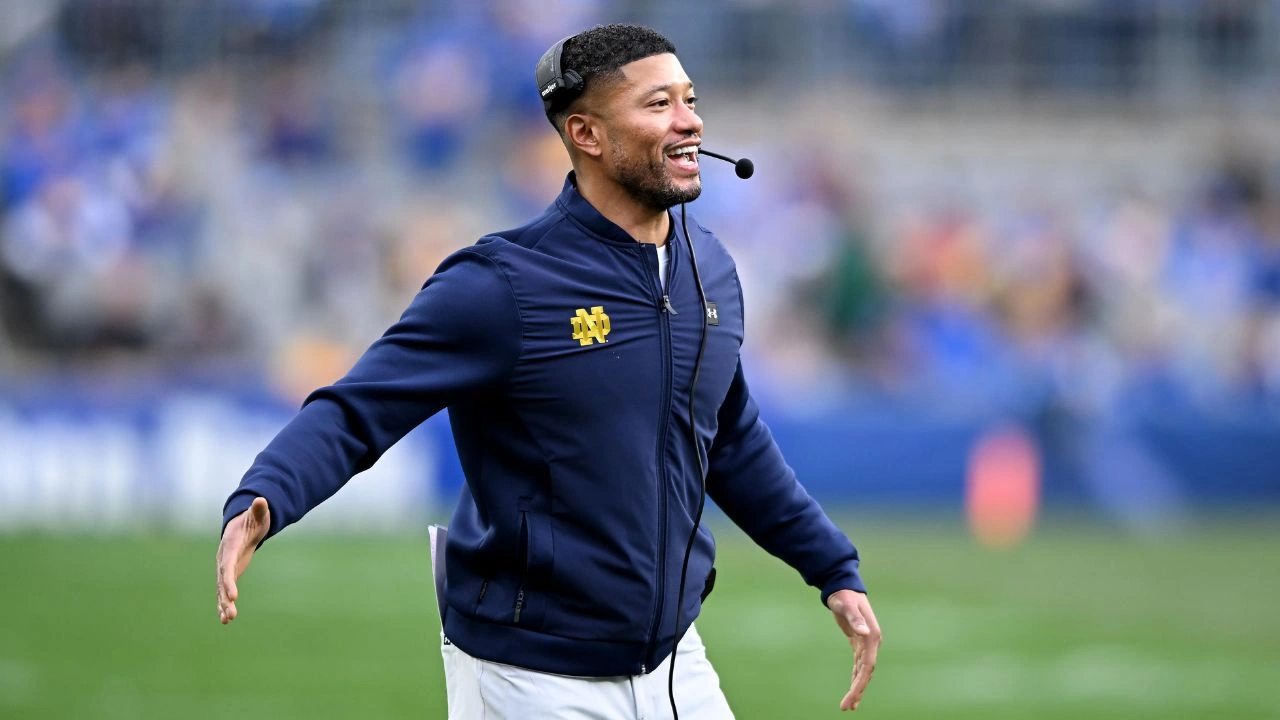
Notre Dame head coach Marcus Freeman found himself at the center of a national debate after appearing on ESPN’s College GameDay during the College Football Playoff National Championship broadcast — just weeks after the Fighting Irish boycotted postseason play in protest of being excluded from the playoff field.
What might normally have been a routine guest appearance quickly became a lightning rod moment in the college football world. Freeman’s presence on the set reignited frustration among Notre Dame fans, drew pointed criticism from national commentators, and exposed broader tensions surrounding the College Football Playoff selection process.
For some, Freeman’s decision to appear on ESPN’s flagship pregame show was seen as pragmatic leadership and an opportunity to defend his program publicly. For others, it felt contradictory — even hypocritical — given Notre Dame’s refusal to participate in the Pop-Tarts Bowl as a statement against what the program viewed as an unjust playoff snub.
The incident has now become a case study in modern college football politics, where protest, branding, television contracts, and playoff legitimacy collide.
This in-depth analysis explores what actually happened, why Notre Dame boycotted its bowl game, why Freeman’s appearance sparked backlash, what fans and analysts are saying, and what this moment means for Notre Dame’s future in the evolving College Football Playoff era.
Setting the Stage: Why Notre Dame Boycotted Its Bowl Game
To understand the controversy surrounding Freeman’s College GameDay appearance, it’s essential to revisit the events that led Notre Dame to take the extraordinary step of boycotting its bowl game.
The Playoff Snub That Shook South Bend
Notre Dame finished the regular season with a record that many believed warranted inclusion in the College Football Playoff. However, when the CFP committee revealed its final four teams, the Fighting Irish were left on the outside looking in.
Instead, the committee selected the Miami Hurricanes for the final playoff spot — a decision largely justified by Miami’s head-to-head victory over Notre Dame earlier in the season and comparable overall records.
For Notre Dame, the decision felt like a betrayal.
University officials, alumni, and fans argued that:
- Notre Dame had stronger overall wins
- The team passed the “eye test”
- The Irish were penalized for scheduling aggressively
- The committee placed too much weight on a single head-to-head result
The reaction in South Bend was swift and emotional.
Read Also: Thunder Dominate Cavaliers: A Statement Win That Redefines NBA Power Rankings
The Pop-Tarts Bowl Boycott: A Statement of Protest
Rather than accept an invitation to the Pop-Tarts Bowl — a postseason game typically viewed as a consolation prize for teams that just miss the playoff — Notre Dame made a stunning announcement.
The program opted out of bowl participation entirely.
Why Notre Dame Refused to Play
Notre Dame leadership framed the boycott as a principled stand.
Their reasoning included:
- The belief that the CFP selection process was flawed
- A desire to protest perceived injustice
- A refusal to legitimize a postseason system they felt had wronged them
- A message to the committee that exclusion had consequences
The move was unprecedented for a program of Notre Dame’s stature.
It immediately polarized the college football world.
Supporters praised the decision as bold and necessary.
Critics labeled it petulant and harmful to players who deserved one final game.
Marcus Freeman’s College GameDay Appearance
The Moment That Reignited the Firestorm
Fast forward to the College Football Playoff National Championship broadcast.
As millions tuned in to watch the season’s final game, ESPN featured Marcus Freeman as a guest on College GameDay — the network’s premier college football pregame show.
Freeman joined hosts Rece Davis and Kirk Herbstreit on set to discuss:
- The playoff selection controversy
- Notre Dame’s decision to boycott its bowl game
- The state of college football
- His program’s outlook moving forward
Almost instantly, social media lit up.
But the most visible reaction came from the crowd itself.
“Pop-Tarts!” Chants: A Public Embarrassment
During Freeman’s segment, fans in attendance — many wearing Miami Hurricanes gear — began chanting “Pop-Tarts!”
The chant was a mocking reference to Notre Dame’s refusal to play in the Pop-Tarts Bowl.
It was loud.
It was sustained.
And it was undeniably awkward.
The moment crystallized the controversy in real time.
Freeman’s Response: Composure Under Pressure
To his credit, Freeman handled the moment with poise.
Rather than reacting defensively or escalating tensions, he:
- Acknowledged the disappointment of missing the playoff
- Reiterated Notre Dame’s commitment to excellence
- Stressed the need to “leave no doubt” in future seasons
- Emphasized accountability within his program
His tone was measured and diplomatic.
“We were disappointed,” Freeman said. “But we have to control what we can control. That means being better next year, scheduling tough opponents, and leaving no doubt.”
For many neutral observers, Freeman’s composure stood out as a positive counterbalance to the surrounding controversy.
Why Freeman’s Appearance Sparked Backlash
Despite Freeman’s professionalism, his decision to appear on College GameDay drew heavy criticism.
The Contradiction Argument
The core criticism was simple:
If Notre Dame boycotted its bowl game to protest ESPN’s CFP ecosystem, why would its head coach appear on ESPN’s biggest platform?
To critics, the optics were terrible.
They argued:
- Appearing on ESPN undermined the boycott’s message
- It made the protest look performative
- It blurred Notre Dame’s moral stance
- It created mixed signals
In their view, Freeman’s presence on the set contradicted the spirit of Notre Dame’s protest.
The Counterargument: Pragmatism Over Symbolism
Supporters of Freeman offered a different interpretation.
They argued that:
- ESPN is the primary platform for college football exposure
- Avoiding media appearances would only hurt Notre Dame’s brand
- Freeman had a responsibility to represent his program
- Publicly addressing the snub helped control the narrative
In this view, Freeman’s appearance was not hypocrisy — it was strategy.
The Broader CFP Controversy
Is the Selection Process Broken?
Notre Dame’s boycott and Freeman’s appearance both highlight a deeper issue:
The College Football Playoff selection process remains deeply controversial.
Common criticisms include:
- Lack of transparency
- Inconsistent criteria
- Overreliance on subjective “eye test” judgments
- Conflicts of interest with TV networks
- Disproportionate emphasis on conference champions
Notre Dame’s exclusion — despite a strong résumé — amplified long-standing concerns about fairness.
Notre Dame’s Unique Position in College Football
1. Notre Dame occupies a rare space in college football.
They are:
- An independent program
- A national brand
- Not tied to a Power Five conference
- Historically influential
This independence complicates playoff politics.
Without a conference championship game, Notre Dame lacks one more data point that CFP committees often value.
That structural disadvantage may have contributed to their exclusion.
Fan Reaction: A Divided Nation
Notre Dame Fans: Defiant and Frustrated
Many Notre Dame fans viewed Freeman’s appearance as necessary and courageous.
They praised him for:
- Representing the program publicly
- Maintaining dignity under heckling
- Calling out systemic flaws
- Standing by the boycott
For them, the real villain was the CFP committee.
Neutral Fans: Conflicted
Neutral fans were split.
Some agreed with Notre Dame’s protest.
Others felt the boycott hurt players more than administrators.
Freeman’s appearance added complexity to an already murky situation.
Critics: Calling Out Hypocrisy
Opponents seized the moment.
They argued:
- You can’t boycott a bowl game but still cash ESPN checks
- You can’t protest the system while benefiting from it
- You can’t demand reform while participating in its spectacle
The chant of “Pop-Tarts!” became a viral shorthand for those critiques.
The Media Perspective
Sports media outlets framed the incident as:
- A cultural flashpoint
- A branding misstep
- A fascinating optics problem
- A referendum on CFP legitimacy
Commentators debated whether Freeman should have declined the invitation.
Some praised his diplomacy.
Others said Notre Dame should have doubled down on its protest by staying off ESPN entirely.
The Business Reality: Why Optics Matter
College football today is as much business as sport.
Television contracts, advertising revenue, and branding exposure drive decisions.
Notre Dame’s relationship with NBC and ESPN makes complete disengagement from media platforms nearly impossible.
From a business standpoint:
- Media silence damages recruiting
- Visibility matters for NIL
- National exposure fuels donor support
Freeman’s appearance, in this context, was economically rational.
The Players’ Perspective: The Forgotten Stakeholders
Lost in the controversy is the impact on Notre Dame’s players.
Many seniors were denied:
- One final game
- A bowl experience
- National exposure
- NFL scouting opportunities
Some players reportedly supported the boycott.
Others privately expressed disappointment.
Freeman’s appearance reopened that emotional wound.
What This Means for Marcus Freeman’s Leadership
This moment will define Freeman’s tenure more than many games.
He faced:
- Heckling
- National scrutiny
- Conflicting institutional interests
- A divided fanbase
And he responded with composure.
That matters.
Freeman demonstrated:
- Emotional intelligence
- Media savvy
- Crisis leadership
- Loyalty to his program
Regardless of opinions about the boycott, his personal handling of the situation strengthened his leadership credibility.
What This Means for Notre Dame’s Future
“Leave No Doubt” as a Mission Statement
Freeman’s words — “leave no doubt” — now define Notre Dame’s roadmap.
That means:
- Stronger non-conference scheduling
- More dominant wins
- Fewer close losses
- Clear playoff résumés
Notre Dame must remove ambiguity from future playoff debates.
A Rematch with Miami Looms
Notre Dame’s scheduled rematch with Miami on November 7, 2026, now carries enormous symbolic weight.
It is no longer just a game.
It is a referendum on playoff justice.
Read Also: Frances Tiafoe vs Francisco Comesana Preview: Australian Open Second-Round Prediction
What This Means for the CFP System
The controversy strengthens the case for:
- Expanded playoff formats
- Automatic qualifiers
- Transparent criteria
- Reduced subjectivity
Notre Dame’s boycott and Freeman’s appearance have become rallying points for reform advocates.
Key Takeaways
- The CFP system remains deeply flawed
- Notre Dame’s boycott exposed systemic tension
- Freeman’s appearance highlighted conflicting realities
- Optics matter as much as principles
- Players remain the silent casualties
Conclusion: A Moment That Will Echo
Marcus Freeman’s College GameDay appearance will be remembered not for what he said — but for what it symbolized.
It symbolized:
- Institutional protest
- Media entanglement
- Cultural contradiction
- Leadership under pressure
Notre Dame’s boycott was a bold statement.
Freeman’s appearance was a pragmatic necessity.
Together, they reveal the uneasy truth about modern college football:
You can protest the system — but you cannot escape it.
1 thought on “Marcus Freeman College GameDay Appearance Sparks Controversy After Notre Dame’s Bowl Boycott”